


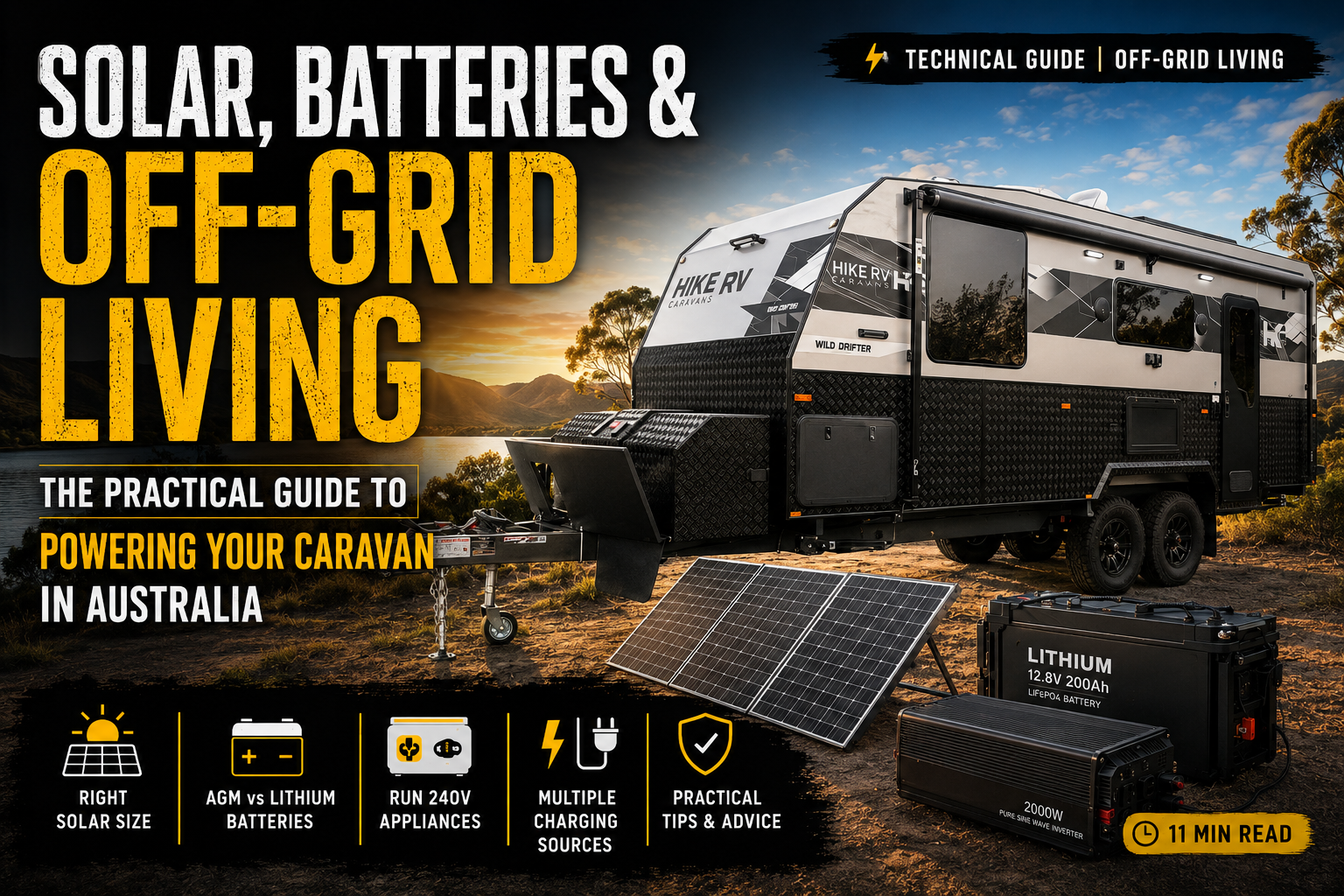
The freedom to park wherever you want, stay as long as you like, and live comfortably without being tethered to a powered site—this is the dream of off-grid caravanning. And with modern solar and battery technology, it's now genuinely achievable for most travelling Australians.
But the power systems space is also full of jargon, conflicting advice, and products that don't perform as advertised. This guide cuts through the noise with practical, honest information for Australian caravanners at every level.
Understanding Your Power Needs: Start Here
The biggest mistake caravanners make when planning their power system is starting with products rather than starting with their actual usage. Before you think about solar panels or batteries, you need to calculate how much power you actually use each day.
Your daily power consumption is measured in amp-hours (Ah) or watt-hours (Wh). Common caravan appliances and their approximate daily consumption:
12V LED lighting: 1-3 Ah/day
Compressor fridge (150L): 30-50 Ah/day (the single biggest consumer)
Water pump: 2-5 Ah/day
Phone and device charging: 5-10 Ah/day
12V fan: 5-20 Ah/day depending on speed and duration
TV (12V): 5-15 Ah/day
Coffee machine (240V inverter): 50-80 Ah per use
Air conditioning (240V): 80-150+ Ah/day — largely impractical off-grid without a generator
Add up your daily usage. This is your starting point for designing your system.
Solar Panels: How Much Do You Actually Need?
Solar panels are rated in watts (W) under ideal conditions—full sun, optimal angle, cool temperature. In real Australian conditions, you typically get 4-6 peak sun hours per day depending on season and location.
A rough calculation: 200W of solar in Australia will generate approximately 800-1,000 Wh (or 65-85 Ah at 12V) on a good day. That's enough to comfortably run a fridge, lighting, and device charging in sunny conditions.
Common System Sizes and What They Power
200W solar: Basic system, fridge + lighting, limited to sunny conditions.
400W solar: Comfortable general caravanning, suits most setups in good conditions.
600W solar: Extended off-grid, handles cloudy days better, suits full-time travellers.
800W+ solar: Full-time living, high consumption loads, serious off-grid setups.
Hike RV Tip: Monocrystalline panels outperform polycrystalline in Australian conditions, particularly in high heat and partial shading. All Hike RV solar-equipped models use monocrystalline panels.
Batteries: AGM vs Lithium - The Honest Comparison
This is the question we get asked most often in our showroom. Here's the straightforward comparison:
AGM (Absorbed Glass Mat) Batteries
AGM batteries are the traditional caravan battery technology. They're reliable, well-understood, and less expensive upfront. But they come with important limitations:
Usable capacity: Only 50% of rated capacity can be regularly discharged without damaging the battery. A 200Ah AGM battery gives you approximately 100Ah of usable power.
Weight: AGM batteries are heavy a 200Ah AGM weighs approximately 60kg.
Charge acceptance: AGM batteries charge slowly and inefficiently at low states of charge.
Lifespan: 400-600 cycles at 50% depth of discharge.
Lithium (LiFePO4) Batteries
Lithium iron phosphate (LiFePO4) batteries have transformed off-grid caravanning over the past five years. The advantages are significant:
Usable capacity: 80-90% of rated capacity is safely usable. A 200Ah lithium gives you 160-180Ah of real power.
Weight: A 200Ah lithium battery weighs approximately 25kg—less than half an equivalent AGM.
Charge acceptance: Lithium batteries accept charge extremely efficiently, even at low states of charge.
Lifespan: 2,000-5,000 cycles—roughly 5-10 times the cycle life of AGM.
The upfront cost of lithium is higher (expect to pay $900-$1,500 for a quality 100Ah lithium battery vs $250-$400 for AGM). But over the life of the battery, lithium almost always works out to be a lower cost per usable amp-hour.
Inverters: Running 240V Appliances Off-Grid
A battery and solar system produce 12V DC power. Most caravan appliances run on 12V, but coffee machines, hairdryers, microwaves, and laptops typically require 240V AC power. An inverter converts your 12V battery power to 240V AC.
Inverters are rated by their continuous wattage output. Common sizes:
1,000W inverter: Laptops, small kitchen appliances, phone chargers.
2,000W inverter: Microwave, toaster, coffee machine.
3,000W+ inverter: Electric frying pan, hair tools (at significant battery cost).
Be aware: High-wattage 240V appliances consume battery power extremely quickly. A 1,200W microwave running for 5 minutes consumes approximately 8.5Ah. Running a hair dryer for 10 minutes consumes 25-30Ah. Plan accordingly.
Charging Your Batteries: Multiple Input Sources
A well-designed caravan power system charges batteries from multiple sources simultaneously:
Solar panels: Primary charging source in good conditions.
DC-DC charger from tow vehicle alternator: Charges while driving, essential for extended trips.
240V mains charger: When you're on a powered site.
Generator: Backup for extended cloudy periods or high consumption needs.
A quality Battery Management System (BMS) or DC-DC charger manages the charge from all these sources intelligently, preventing overcharging and optimising battery health.
What Hike RV Offers: Factory-Installed Power Systems
Hike RV's off-road and touring models are available with factory-installed solar and battery packages—designed and integrated by our team rather than bolted on after the fact. Factory integration means properly rated cables, correctly positioned panels, accessible battery compartments, and a system that's been tested as a complete unit.
We offer lithium battery upgrade packages, additional solar capacity options, and DC-DC charger integration. Talk to our team about building the right power system for your intended travel style and duration.
Want to understand exactly what power setup your Hike RV needs for your travel plans? Our team will walk you through the numbers at our Campbellfield showroom. No jargon—just practical advice.