


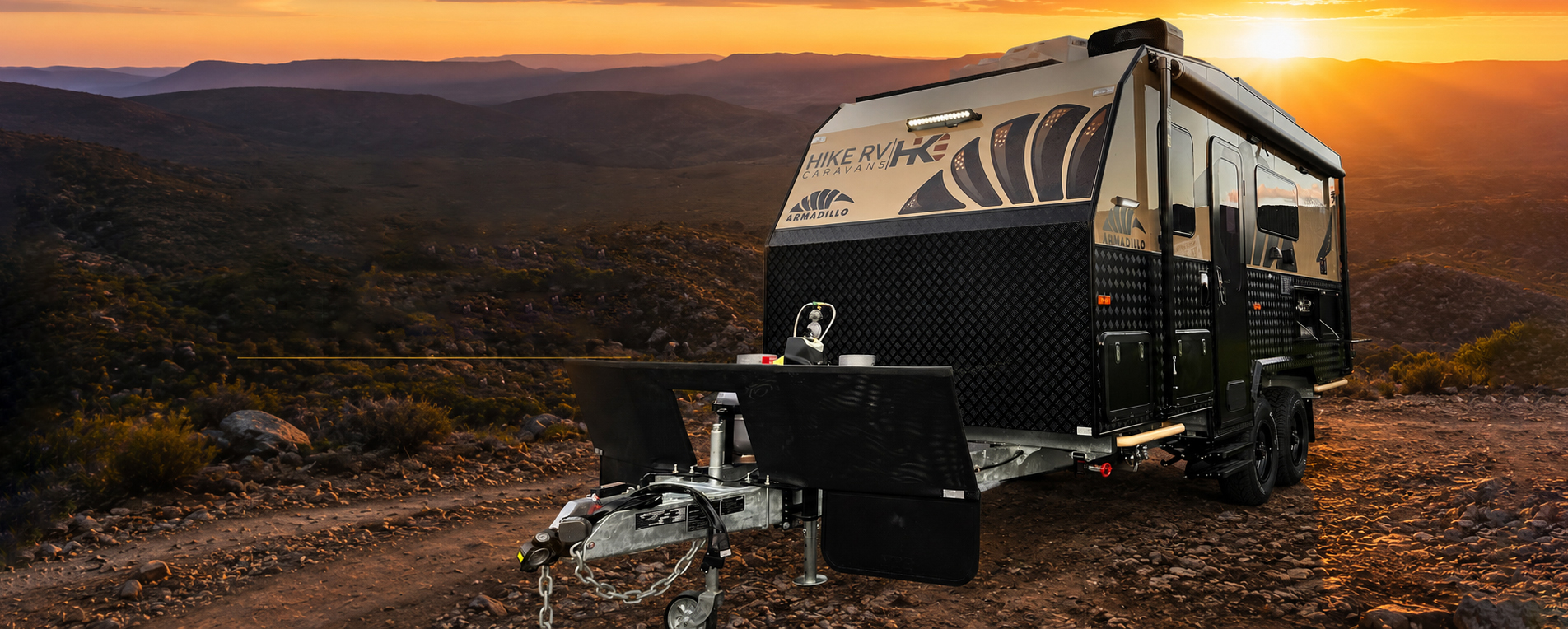
The Ultimate Guide to Off-Road Caravanning in Australia: What You Need to Know Before You Go
This guide is your starting point — whether you're planning your first track or upgrading to a serious rig for the big lap.
What Makes a Caravan Truly Off-Road Capable?
The term 'off-road caravan' is used loosely in the industry. Not everything marketed as off-road will survive an outback corrugated track for more than a few days. Here's what genuine off-road capability actually looks like:
1. Independent Suspension
Standard caravan leaf spring suspension cannot absorb the repeated impact of corrugated dirt roads without transferring that stress directly into your van's structure. Independent suspension — typically a trailing arm or coil spring system — allows each wheel to respond to the road surface individually, dramatically reducing structural stress and improving stability.
2. Heavy-Duty Chassis
Your chassis is the skeleton of your caravan. An off-road chassis is typically constructed from RHS (Rectangular Hollow Section) steel, fully welded with gussets at stress points, and hot-dip galvanised or powder-coated for corrosion protection. Check the chassis specs before any off-road purchase — a lightweight touring chassis will crack on serious tracks.
3. Coupling and Hitch
An off-road coupling must allow articulation in multiple directions — vertical, horizontal, and rotational. Standard ball couplings are not designed for severe undulation and can cause coupling stress failures. Look for an off-road hitch rated for the terrain you plan to cover.
4. Water Tanks
Remote Australia means you need to carry your own water. Serious off-road setups carry 200–400 liters of fresh water. Tanks should be mounted low in the chassis (keeping the center of gravity low), protected from rock strikes, and made from food-grade polyethylene.
Essential Off-Road Caravan Gear
Even the toughest caravan needs support equipment to handle genuine remote travel:
• Recovery gear: snatch strap, shackles, high-lift jack or airbag jack
• Spare tyre — ideally two for remote outback travel
• Solar panels and lithium battery setup for extended off-grid camping
• Portable air compressor for tyre pressure management on tracks
• Jerry cans for additional fuel and water capacity
• Satellite communicator (EPIRB or PLB) for areas with no mobile coverage
• First aid kit and remote-area medical guide
Reading the Track: Know Before You Go
Not all dirt roads are created equal. A quick scan of satellite imagery does not tell you what conditions are actually like on the ground after recent rain, or what track rating applies. Australia uses a recognised track rating system:
• 2WD tracks: Graded unsealed roads suitable for any vehicle
• 4WD tracks: Require four-wheel drive, low range may be needed
• 4WD only - high clearance: Serious terrain, heavy vehicles only
• Remote tracks: No facilities, no regular maintenance, no mobile coverage
Always check with local councils, National Parks offices, or the Hema Maps app before heading onto a remote track. Conditions change seasonally and after rainfall. A track that's passable in summer may be completely impassable after winter rains.
How Hike RV Builds for Australian Off-Road Conditions
Hike RV caravans are engineered specifically for Australian conditions — not adapted from European touring van designs. Every off-road model starts with a purpose-built heavy-duty chassis, independent suspension, and construction methods that account for the unique demands of Australian outback travel.
Our off-road range uses high-strength composite walls rather than traditional aluminium cladding over timber frame — this construction is significantly more resistant to moisture, rot, and the repeated flexing that destroys traditional builds on rough tracks.
💡 Hike RV Tip: Ask about our all-terrain tyre specification on off-road models. Standard highway tyres are not adequate for off-road travel — all Hike RV off-road models come with tyres matched to their intended use.
Planning Your First Off-Road Trip
For your first off-road adventure, choose a well-documented track with facilities and mobile coverage as a backup. The Gibb River Road in WA, the Oodnadatta Track in SA, and the high-country tracks of the Victorian Alps are all popular first-time off-road destinations with strong online communities sharing current conditions.
Travel with another vehicle where possible. Not because you'll necessarily need help — but because if something goes wrong in a remote area, having a second vehicle is the difference between an inconvenience and an emergency.
─────────────────────────────────────────────────────
Hike RV's off-road range is built to go where others can't. Visit our Campbellfield showroom to see the full off-road lineup and talk to our team about the right setup for your intended tracks.